WHAT · Identify the AC
Identify the precise authorial choice in the evidence. Name what the creator has chosen: a word, phrase, image, visual relationship, structural feature or other defensible choice.
Use one specific piece of evidence to practise the analytical process: identify the authorial choice, deconstruct the details, and explain what they reveal about the IDEA. Compare teacher-supplied EA examples from Paper 1 work across five levels.
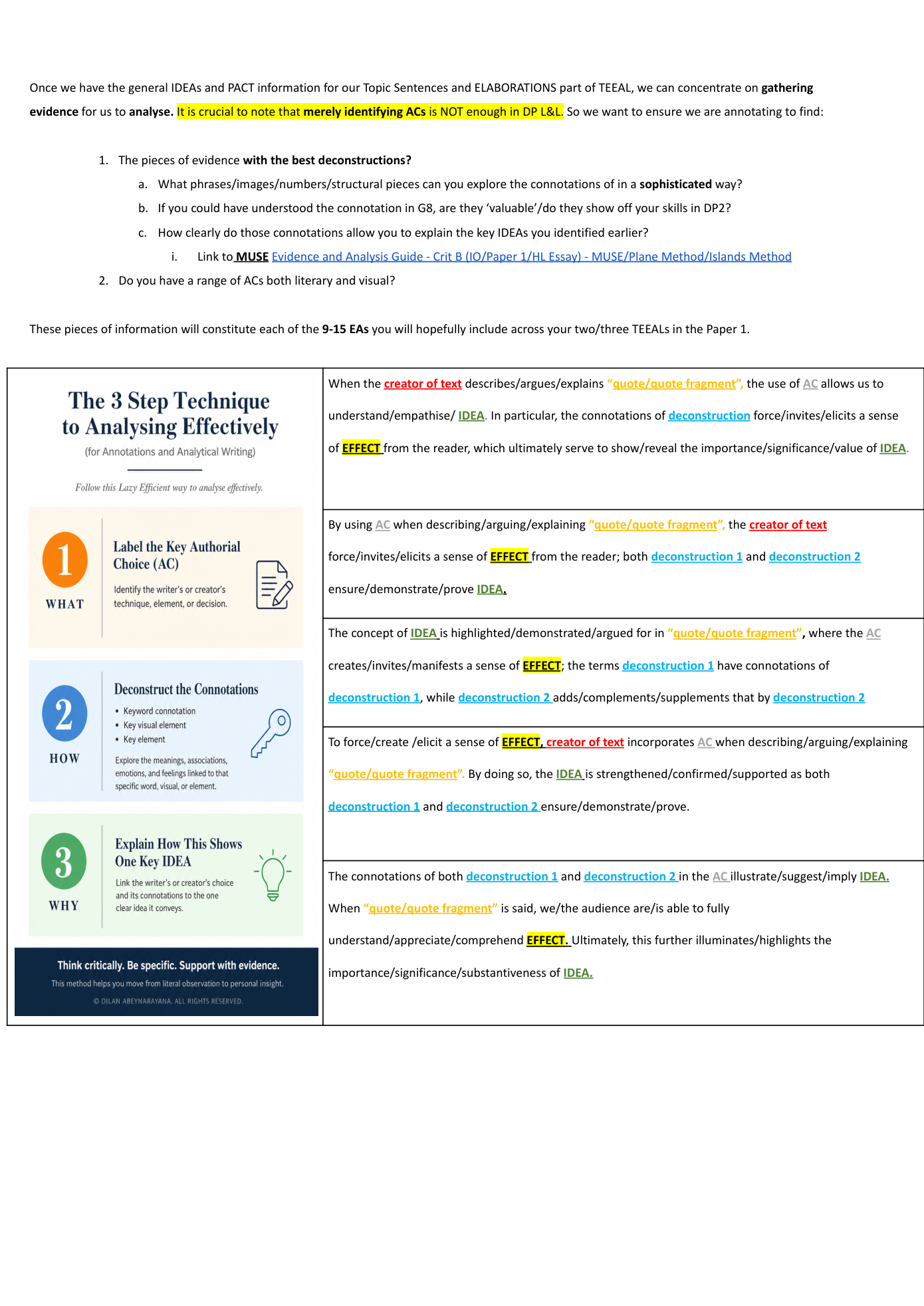 Original 3-Step TechniqueOriginal Evidence & Analysis guide, including the three-stage diagram
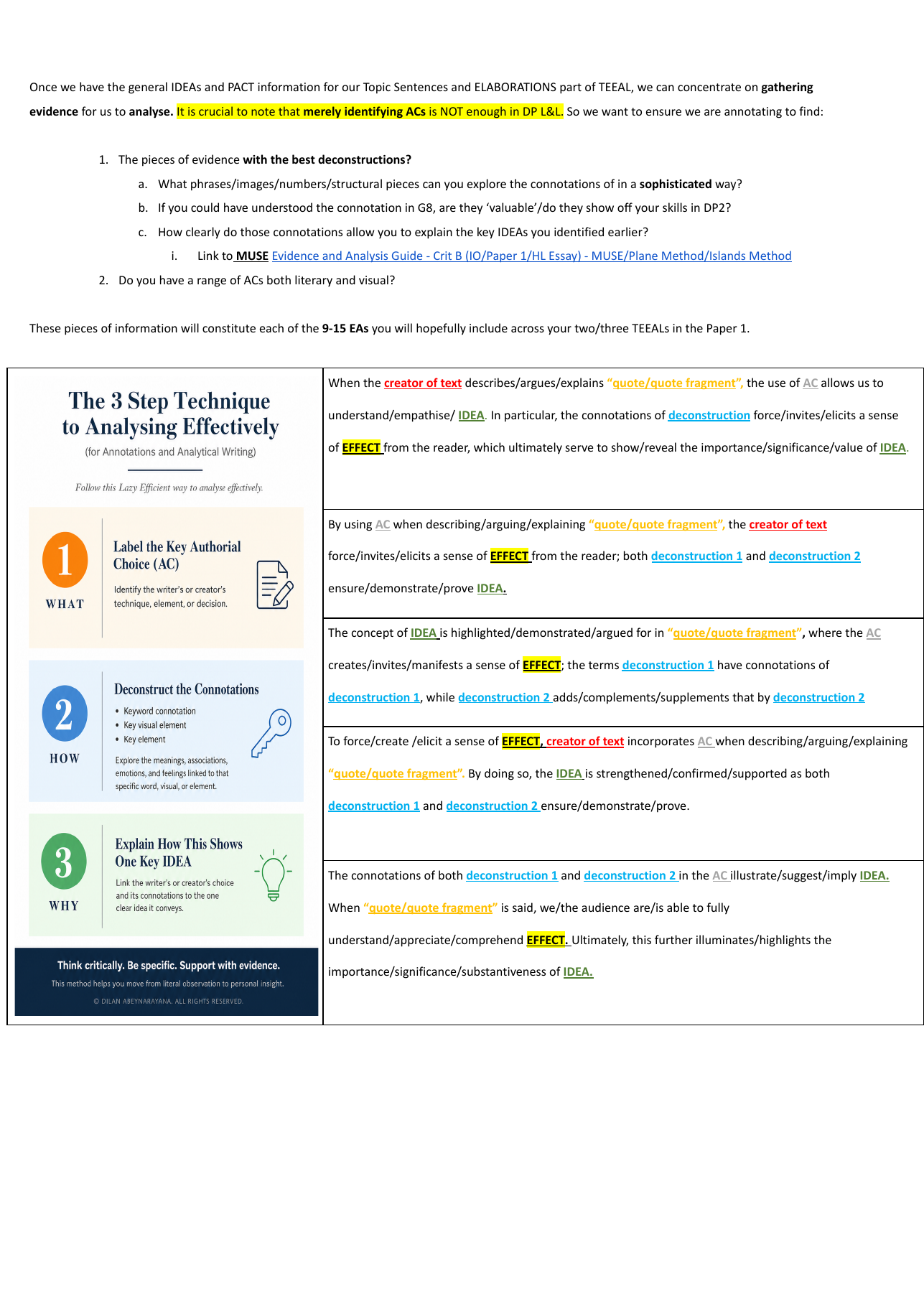 Ways to Phrase EAs / DeconstructionsSource guide, page 6 · original sentence-construction models
 Criterion B: What is evaluation?Deconstruction, connotations and the 3-Step Technique · Watch on YouTube ↗
Identify the precise authorial choice in the evidence. Name what the creator has chosen: a word, phrase, image, visual relationship, structural feature or other defensible choice.
Examine the specific details and their contextual connotations. Explain why those details carry those implications in this text. Consider how the details work together.
Explain what the deconstruction reveals about the creator’s IDEA. The analysis must establish what this evidence contributes to the text’s specific argument or representation.
The evidence remains the same. Examine how the analysis changes.
Use these descriptions to identify the analytical operation that is present or missing. They describe the quality of the thinking, not a word-count target.
Content is recounted, or an effect is asserted without explaining the specific choice or its relationship to an IDEA.
The AC is identified and its immediate or literal effect is understood. The explanation remains broad.
Some interpretation, deconstruction or IDEA connection appears, but the reasoning is incomplete or inconsistent.
Key words or visual details are deconstructed and connected to a clear IDEA. Some reasoning may remain less developed.
Precise details and their connotations are integrated into a clear explanation of the IDEA. It develops the 4/5 reasoning rather than merely extending it.
Judge what the response actually explains. Do not reward length, terminology or evaluative adjectives on their own.
Some expressions below are explicitly prohibited in the existing language policy; others are examples from examiner feedback or generic effects that are insufficient as completed analysis. The distinction matters: the generic phrases are not automatically lexical bans in every context, but they do not demonstrate how the specific evidence develops an IDEA.
Other generic effects also require specific explanation: “engages the reader”, “creates interest”, “creates pathos/logos/ethos”, “the number creates logos”, “the photograph creates credibility”, or “the colour represents safety” without evidence from the actual text. The issue is the unsupported or transferable claim, not simply the presence of a technical term.
Submit your own analysis. The coach uses the selected examples, your work and the wider examiner-informed teaching corpus to identify one useful next step.
Practice calibration only. Any reference to a 1/5–5/5 example describes proximity to the teaching models, not an IB mark or predicted assessment result. Your writing is sent to the site's existing AI coaching service when you submit.
The 4/5 and 5/5 exemplars retain the teacher-supplied wording. Levels 1/5–3/5 are revised practice versions; the original supplied versions remain in the downloadable project record. They are analytical teaching examples, not IB-issued mark schemes or official numerical Criterion B marks.